
★ Back to School Finds That Give Back · 2026
10 Back to School Finds on Amazon That Actually Give Back (2026)
The school list is getting bought either way.
The average K-12 family plans $863.86 on back to school this season, part of a record $43.3 billion.* Almost none of that money is asked to do anything except exist.
This list asks it to do one more thing. Every pick below is on Amazon, in the cart you already have open, and comes from a brand with a give-back or social program we verified on the brand's own site in August 2026.
One thing most lists get wrong, and this one will not: several famous give-back programs have quietly changed. TOMS retired buy-one-give-one years ago. Other brands moved from "one donated per sold" to "a percentage of proceeds." Where a program changed, the card quotes the brand's current wording, not the version that went viral.
No pick is here because of its cause. Each one had to be the thing we would recommend anyway; the cause is why it beat a tied rival.
This guide covers the 10 best back to school finds on Amazon in 2026 with a verified give-back attached: one-for-one school supplies, recycled stainless lunch gear, backpacks that fund education programs, and the teacher gift that donates soap and clean water.
The best give-back school buys are the things already on your list, from brands whose giving you can verify: Yoobi school supplies (one item donated to the Kids in Need Foundation per qualifying item), PlanetBox's certified recycled stainless lunch box, Klean Kanteen's B Corp kids bottle, and Bixbee backpacks with a "One Here. One There." donation mission.
For the teacher, Hand in Hand soap donates a bar of soap and a month of clean water to a child in need for every product purchased. For the classroom, Who Gives A Crap tissues route 50% of profits to clean-water nonprofits.
All 10 picks are on Amazon with official brand storefronts, so the giving rides along on the cart you already have open. Every claim was checked on the brand's own site in August 2026.
Shoppers are keeping value front and center as they look for ways to make their dollars go further.
Mark Mathews, Chief Economist, National Retail Federation§
Top 10 back to school finds that give back
✓ Give-back claims verified on each brand's own site, and Amazon availability checked, August 2026. Amazon prices move; each card states the brand's list price where published.
| Rank | Find | Best for | The give-back |
|---|---|---|---|
| 1 | Yoobi supply kit | The whole supply list | One item donated per qualifying item (Kids in Need Foundation) |
| 2 | PlanetBox Rover | Lunch, K-5 | Certified 49-91% recycled stainless, no single-use plastic |
| 3 | Klean Kanteen Kid's Classic | The water bottle slot | B Corp; 90% recycled steel (Intertek-certified); 1% for the Planet |
| 4 | Cotopaxi Batac 16L Del Día | Middle & high school | 1% of revenue to anti-poverty grants |
| 5 | Bixbee kids backpack | Elementary kids | "One Here. One There." backpack & supply donations |
| 6 | TOMS Youth Alpargata | Everyday dry-weather shoes | Purchases fund children's education & health grants |
| 7 | Decomposition Book | Notebooks | 100% post-consumer recycled paper, made in USA |
| 8 | OOLY gel pens | The fun extras | Women-owned, founder-run since 2005 |
| 9 | Who Gives A Crap tissues | Classroom restocks | 50% of profits to clean-water nonprofits |
| 10 | Hand in Hand soap | Teacher gifts | A bar of soap + a month of clean water donated per product |
How to spot a real give-back program (3 quick tests)
The give-back aisle has a specific problem: the most famous claims are the most likely to be out of date, and "eco-friendly" costs nothing to print. Every pick on this list passed 3 tests. Run them on anything else you buy too.
1. The specificity test
"For each qualifying item purchased, we donate an item to Kids in Need Foundation" is checkable. "We care about giving back" is not. A real program names a number, a partner, or a place. If the claim has no noun you could verify, it is decoration.
2. The third-party test
B Corp, GOTS, Fair Trade, and an Intertek recycled-content certificate are someone else's audit. A green leaf drawn on the label is the brand grading its own homework. Certifications are not everything, but a brand that submits to one is making a claim it can be caught breaking.
3. The currency test
The claim should be live on the brand's own site today, not in a story you remember. This is the test the famous brands fail: TOMS retired buy-one-give-one, and several rivals moved to "a percentage of proceeds." Every claim on this page was read on the brand's own site in August 2026, and each card quotes the current wording.†
What this list does with a claim we could not verify
It leaves it off the page. A few brands you might expect here are missing for exactly that reason; the "claims to avoid" section below names the failure patterns without dunking on anyone by name.
🎯 Gift finder
Answer 4 quick questions, get your gift
Fast-track to the right pick, or skip it and browse the ranked list below.
1 Yoobi one-for-one school supply kit
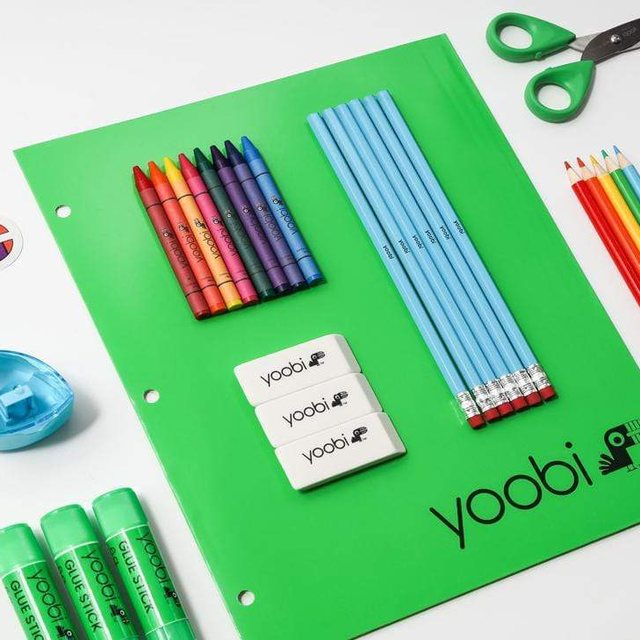
Best for: The whole generic supply list: pencils, notebooks, folders, full kits, one cart.
The give-back: "For each qualifying Yoobi item purchased, Yoobi Global, LLC will donate a Yoobi item to Kids in Need Foundation." That is the site's own legal footer, not a marketing banner, and the brand counts 6 million+ kids reached.†
The supply list is the most annoying purchase of the season precisely because it is so generic. Nobody has feelings about a 48-pack of pencils.
Yoobi is the exception, and not because the pencils are different. Because each qualifying item you buy sends an item to a classroom that runs short, through the Kids in Need Foundation, which supplies teachers and students in under-resourced US schools.
It is the only pick on this list where the cause is the category itself: school supplies that generate school supplies.
Why it earns the spot
Zero behavior change. Yoobi has an official Amazon storefront with kits, pencils, notebooks, and licensed lines, at ordinary supply-aisle prices.
The pledge is one-for-one and in writing, which almost nothing in this category can still say.
Where it can go wrong
The scoreboard is stale even though the pledge is live. The published impact stats on Yoobi's how-we-give page date to fiscal 2023; the one-for-one commitment itself is current sitewide.
And the catalog is smaller than a big-box aisle. If your school demands one specific brand of pencil, this is not that.
Best version of this find
The multi-piece supply kit. One box covers most of an elementary list in one click, and every qualifying item in it counts toward a donation.
2 PlanetBox Rover lunch box
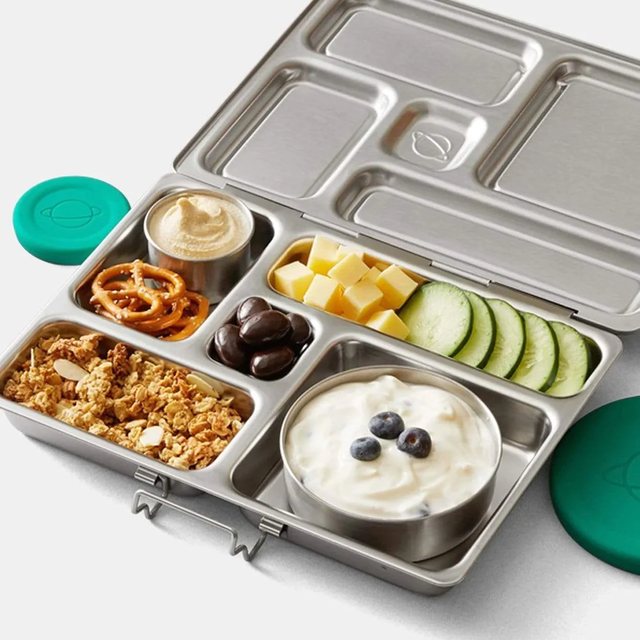
Best for: K-5 kids whose lunch is compartments-shaped: a main, some sides, nothing soupy.
The give-back: The Rover's tray and lid are certified 49% post-consumer recycled stainless steel, the Dipper bowl is certified 91%, and the brand's stated rule is no single-use plastic.†
Most lunch boxes are a subscription. You buy one in August, it cracks by January, and you buy another.
The Rover is the opposite bet: one stainless box that outlasts the elementary run entirely. The recycled-content claim comes with percentages, which is the difference between an eco claim and an eco vibe.
Why it earns the spot
The bento layout ends the daily baggie run, which is where most lunchbox waste actually comes from.
PlanetBox sells through its own official Amazon storefront, and the new Rover ASINs are the recycled line, matching the claim on the brand's site.
Where it can go wrong
It is real money for a lunch box, and stainless is heavier than plastic. A kindergartner will feel the difference in a small backpack.
If your household loses gear weekly, losing this box once erases the durability math.
Best version of this find
The Rover set that includes the Dipper bowl, which is the 91% recycled piece. Brand list price is $54.95 (on sale for less at planetbox.com when we checked); Amazon's price moves, so check the listing.
3 Klean Kanteen Kid's Classic bottle
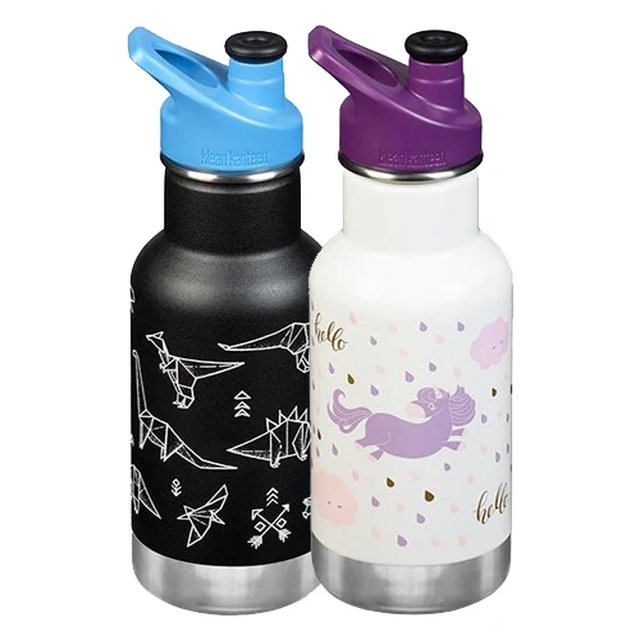
Best for: The water bottle slot, filled once, with the claim a third party has audited.
The give-back: Klean Kanteen is a certified B Corp, runs 90% post-consumer recycled steel across most of its line with certification by Intertek, has been climate-certified since 2020, and reports $4.4 million+ donated through 1% for the Planet.†
Every eco water bottle says it is saving the planet. Klean Kanteen is the one whose steel claim someone else has actually checked.
90% post-consumer recycled stainless, certified by Intertek, from a B Corp that has been climate-certified since 2020. That is the strongest verification stack in this entire list.
Why it earns the spot
Kid-sized (12oz), insulated, with swappable caps, so a chewed spout is a replacement part rather than a replacement bottle.
The official Klean Kanteen Amazon store has a dedicated kids page with the kid-print colorways.
Where it can go wrong
Steel dents and weighs more than the plastic bottle it replaces. Small kids notice.
Brand list price is $25.95 for 12 ounces; that is the price of the certification stack. The uninsulated version is cheaper if lukewarm water is acceptable.
Best version of this find
The 12oz Insulated with the sport cap for elementary kids. Size up only when the kid can comfortably carry it.
4 Cotopaxi Batac 16L Del Día backpack
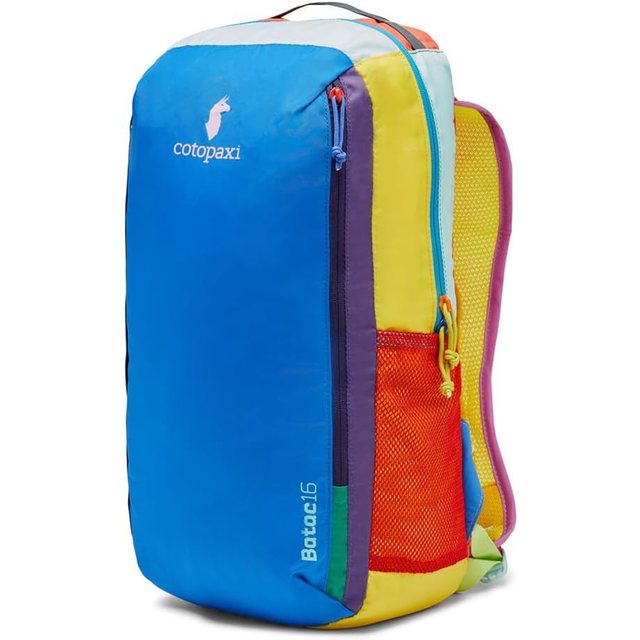
Best for: Middle and high schoolers who want a bag nobody else at school has.
The give-back: 1% of Cotopaxi's annual revenue goes to the Cotopaxi Foundation, a 501(c)(3) making grants against extreme poverty, focused on health, education, and livelihoods, primarily in Latin America.†
Every Del Día pack is a one-of-a-kind colorway. You pick the style; the colors pick you. For a 13-year-old allergic to matching anyone, that is the whole sales pitch.
Behind the colors is the most structured giving on this list that is not one-for-one: a named foundation, published grantmaking focus, 4.25 million people reached by the brand's own count.
Why it earns the spot
16 liters swallows a binder, a lunch box, and a hoodie. The official Cotopaxi Amazon store even has a dedicated Del Día page.
Revenue-percentage giving survives fads: it does not depend on which product is trending.
Where it can go wrong
Nothing about your specific $70 is earmarked, the way a one-for-one purchase is. It is real giving, structured, but indirect.
And it is a small adult pack, not a kids' bag. Check the fit on anyone below middle school.
Best version of this find
The Batac 16L in Del Día. Brand list price is $70; the "surprise colorway" listing is the honest version of the product, since that is how Del Día works.
5 Bixbee kids backpack
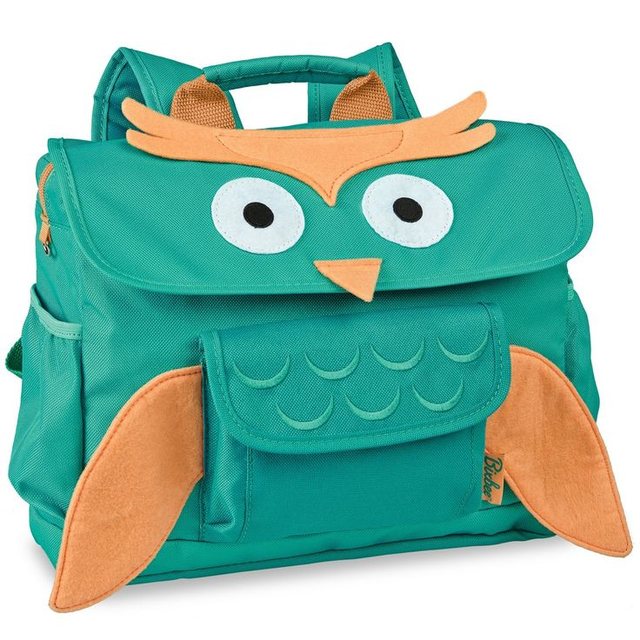
Best for: Elementary kids: right-sized ergonomic packs in kid-first designs.
The give-back: Bixbee's stated social mission, "One Here. One There.", partners with nonprofits to give children in need access to education, including backpack and school-supply donations.†
Here is the surprise of this research round: Bixbee, widely reported gone, is alive, selling, and still carrying its "One Here. One There." mission on its own site.
The packs themselves are built for actual small humans: scaled-down, lightweight, with designs (sparkly rockets, dinosaurs, fireflies) aimed at the kid rather than the parent.
Why it earns the spot
It is the only give-back backpack on this list actually sized for the K-2 crowd, which is exactly where Cotopaxi does not fit.
There is an official Bixbee storefront on Amazon.
Where it can go wrong
The mission page publishes no donation counts, so this give-back is stated but not scoreboarded. We say that plainly rather than inventing a number.
Neither Amazon nor the brand site showed a stable price at our check, so confirm the listing price and the "Sold by" field before buying.
Best version of this find
The sparkalicious or dino styles in the medium size for K-2; check the size chart against your kid, not their grade.
6 TOMS Youth Alpargata canvas slip-ons
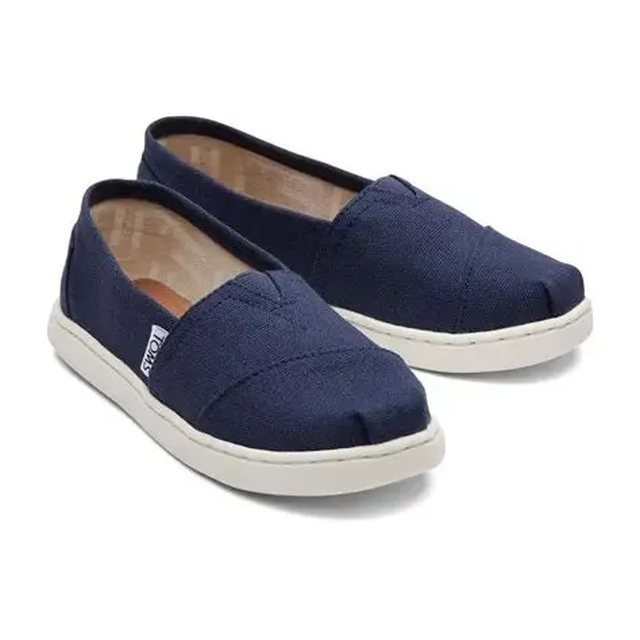
Best for: Easy-on everyday shoes for the mostly-dry walk to school.
The give-back: TOMS' current model, in its own words: "your TOMS purchase helps support children's education, health and well-being." $200M+ given and 100 million+ pairs donated since 2006. The famous pair-for-pair model itself is retired.†
TOMS is the brand everyone thinks of first for give-back shopping, and almost everyone describes its program wrong.
The buy-one-give-one shoe model ended years ago. What replaced it is grant-based giving for children's education, health, and well-being, documented in a 2025 impact report. Real, current, and different from the slogan.
Why it earns the spot
At around $35 for the Youth Alpargata, it is the correct amount of money for a shoe a kid outgrows in 2 semesters.
Slip-on canvas means zero morning shoelace negotiations. TOMS sells on Amazon through its official storefront, with some youth listings sold by Amazon itself.
Where it can go wrong
Canvas soaks through. This is the second pair, not the rain pair, and not the PE pair either if arch support is on the pediatrician's list.
If the one-for-one story is why you loved TOMS, know that it ended; what remains is real but different.
Best version of this find
The Youth Alpargata Classic in a dark colorway that hides playground wear.
7 Decomposition Book recycled notebooks
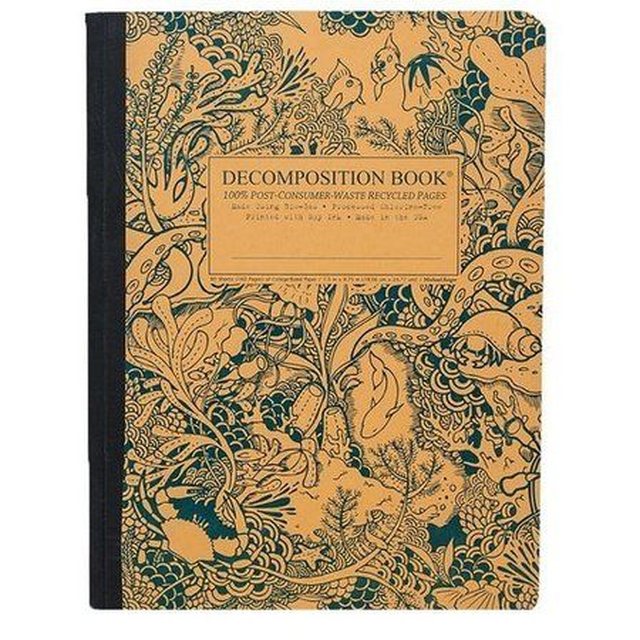
Best for: The notebook line-items, upgraded to 100% recycled without a big-box detour.
The give-back: Every Decomposition Book is made with 100% post-consumer recycled paper and manufactured in the USA by Michael Roger Inc.†
A composition book is a composition book, except this one did not require new trees and was printed in the USA.
The covers (honeycomb, celestial, topo maps) are the rare case where the recycled option is also the one kids pick on purpose.
Why it earns the spot
The claim is a number, not an adjective: 100% post-consumer recycled paper, stated on the product line itself.
The official Decomposition storefront on Amazon carries college-ruled, graph, and spiral variants.
Where it can go wrong
$12 for a standard notebook is roughly 10 times a sale-priced comp book. The $6 pocket size softens the math.
Third-party listings sometimes add soy-ink and FSC claims that the brand's own page does not make, so this page does not repeat them.
Best version of this find
3 standard-size books, one per heavy subject, in one order.
8 OOLY gel pens
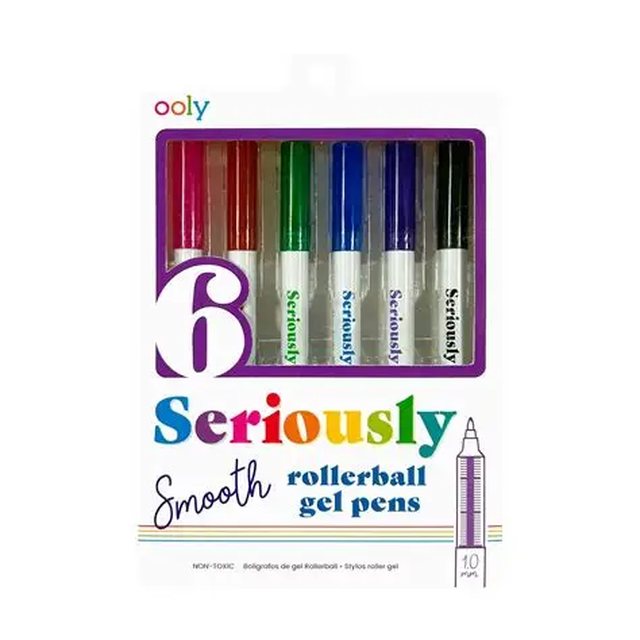
Best for: The pencil-case extras your kid actually wants: gel pens, markers, erasers.
The give-back: OOLY is a women-owned business headquartered in Carlsbad, California, founded by Carol Pankiw in 2005 and still founder-run.†
Somewhere on every list is the fun line item. The gel pens. The scented markers. The eraser shaped like food.
OOLY makes exactly this stuff, and buying it from a founder-run, women-owned maker instead of the big-box shelf costs approximately nothing extra: a 12-set of gel pens is ordinary gel-pen money.
Why it earns the spot
2 million+ boxes of its flagship gel pens sold, per the brand, and an official Amazon storefront with a dedicated gel-pen page (some listings still bylined "International Arrivals," OOLY's original company name).
Where it can go wrong
This is the lightest give-back on the list. It is a who-you-buy-from pick, not a donation program, which is why it sits at #8 and not #2.
Scent and glitter are a classroom gamble; some teachers ban both, and nobody refunds a confiscated pen.
Best version of this find
The Color Luxe 12-set for older kids, or the scented glitter set for the under-10 crowd if the classroom allows it.
9 Who Gives A Crap bamboo tissues
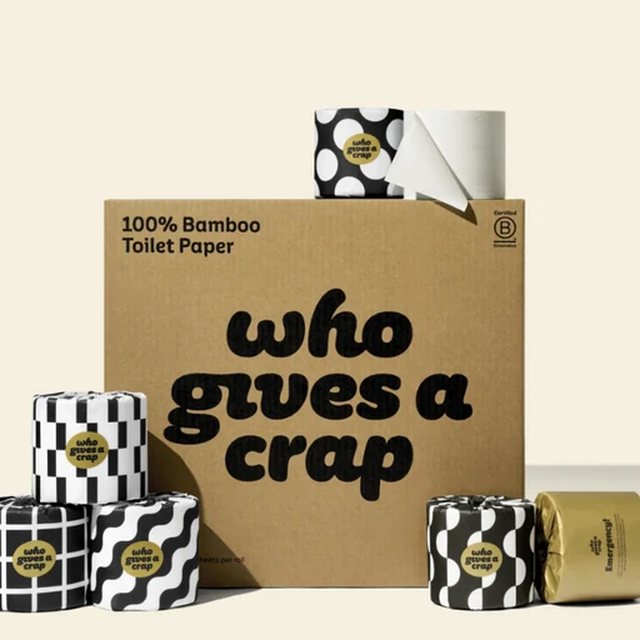
Best for: The classroom supply-list line nobody thinks about: tissues, by the dozen.
The give-back: Who Gives A Crap donates 50% of profits to clean water and sanitation nonprofits (WaterAid, Water For People, Fresh Life), with $14.4 million+ raised to date, per its own impact page.†
Half the school supply lists in America include a box of tissues for the classroom. It is the least glamorous purchase of the year.
It is also, quietly, the strongest give-back on this list by percentage: half the profits fund clean water and sanitation projects. On a purchase this boring, that is a free upgrade.
Why it earns the spot
Bamboo instead of tree fiber, a 12-box format that covers the classroom donation plus your own flu season, and an official storefront on Amazon (yes, they are really on Amazon in the US).
Where it can go wrong
"50% of profits" is not "50% of your purchase." Profits are what is left after costs; the number is real and audited-adjacent but smaller than it sounds.
Kid appeal is zero. This one is for you and the teacher.
Best version of this find
The 12-box facial tissue pack: send 2 boxes to the classroom, keep 10 for the plague months.
10 Hand in Hand soap
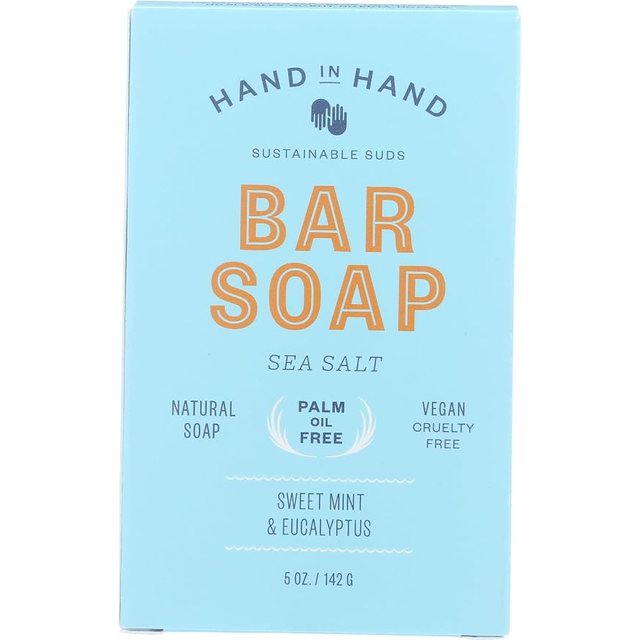
Best for: Teacher gifts, end-of-week thank-yous, and the class gift that is not a mug.
The give-back: Hand in Hand's pledge, on its own impact page: "for every product purchased, Hand in Hand works with our partners to donate one bar of soap + one month of clean water to a child in need." 13.89 million bars donated, 1,468 schools reached, by the brand's count.†
The teacher gift problem: candles are a scent gamble, mugs are a landfill program, gift cards feel like homework math.
A Hand in Hand set threads it. Nice enough to feel like a gift, useful enough to get used, and every product bought donates a bar of soap plus a month of clean water to a child in need.
Why it earns the spot
It is a true buy-one-give-one, stated in the brand's own words, with school-specific impact numbers (1,468 schools).
Bars run about $5 to $7, so a 3-bar bundle lands in normal teacher-gift territory, and there is an official Hand in Hand storefront on Amazon.
Where it can go wrong
Soap as a gift can read as a hint if you hand over a single bar. Make it a set, add a note that names the give-back, and it reads as intended.
Scented products are still scented; for a fragrance-free classroom, this one is for the teacher's home, not the desk.
Best version of this find
A 3-bar set with the donation story in the gift note; the note does half the gift's work.
Give-back school finds by kid and situation
Use this section if you are shopping for a specific kid, budget, or deadline.
| Situation | Start with |
|---|---|
| Kindergarten or early elementary | Bixbee backpack, 12oz Klean Kanteen, Yoobi kit |
| Middle or high school | Cotopaxi Batac Del Día, Decomposition Books, OOLY pens |
| Multiple kids, one order | Yoobi kits (every item counts), tissue 12-pack |
| The teacher | Hand in Hand set, plus a classroom tissue drop |
| Under $15 per item | Decomposition pocket books, OOLY pens, Hand in Hand bars |
| Buy once, keep for years | PlanetBox Rover, Klean Kanteen |
| The strongest give per dollar | Yoobi and Hand in Hand (true one-for-one), Who Gives A Crap (50% of profits) |
| The kid picks, you approve | Del Día colorways, OOLY, Bixbee designs |
Quick comparisons: which give-back find wins?
Head-to-head calls for the 3 decisions parents ask about most.
Cotopaxi vs. Bixbee for the backpack slot?
Age decides it. Bixbee is built and sized for elementary kids and donates backpacks and supplies through its "One Here. One There." mission; Cotopaxi's Batac 16L is a small adult pack with one-of-a-kind colorways and 1% of company revenue routed to anti-poverty grants. K-5 goes Bixbee; middle school and up goes Cotopaxi.
| Bixbee | Cotopaxi Batac 16L | |
|---|---|---|
| Sized for | Elementary kids | Middle school and up |
| The give | Backpack & supply donations (no published counts) | 1% of revenue, named foundation, published focus |
| Style logic | Kid-first designs | One-of-a-kind colorways |
| Price at check | Not listed, confirm on Amazon | ~$70 brand list |
PlanetBox vs. a $15 plastic lunch box?
PlanetBox wins if the box will survive your household; the plastic box wins if it will not. One $55 stainless box that lasts 4 school years beats 4 cracked plastic ones, and it is the certified-recycled option. But losing a $55 box once erases the math, so know your kid.
| PlanetBox Rover | Typical plastic box | |
|---|---|---|
| Materials | Certified 49-91% recycled stainless | Virgin plastic, uncertified |
| Expected life | The elementary run | 1 school year, often less |
| Weight | Heavier; small kids notice | Light |
| Cost over 4 years | ~$55 once | ~$60 in $15 replacements |
TOMS vs. any $35 canvas shoe?
On the shoe alone, it is a tie, and that is the point. The Alpargata is a normal, decent canvas slip-on at a normal price. What breaks the tie is a documented giving program ($200M+ since 2006, current impact report). When two shoes are equal, take the one whose receipt funds kids' programs.
| TOMS Youth Alpargata | Generic canvas slip-on | |
|---|---|---|
| Shoe quality | Standard canvas slip-on | Standard canvas slip-on |
| The give | Grant-funded children's programs, documented | None |
| Rain days | No | Also no |
| Price | ~$35 | $20-$40 |
Whichever way these calls go for your family, the Yoobi supply kit is the pick that works in every scenario, which is why it is #1.
Teacher gifts and classroom give-backs
Teacher gifting works best when it is useful, not performative. Teachers spend an average of hundreds of their own dollars a year on classroom supplies; a gift that restocks the room beats a gift that decorates it.
3 moves that land:
- The classroom restock: a Who Gives A Crap 12-pack covers the supply-list tissue line for the whole class, and half the profits fund clean-water projects.
- The personal thank-you: a Hand in Hand set with a note that names the donation. The note does half the work.
- The class gift: pool the class fund into a Yoobi order for the classroom. Every qualifying item doubles itself through the Kids in Need Foundation, which supplies teachers exactly like the one you are thanking.
One caveat that saves embarrassment: check whether the classroom is fragrance-free before gifting anything scented, including soap and candles.
Under-$15 add-ons that still give back
The end of the list is where give-back shopping usually dies: nobody researches a $9 purchase. These 3 are pre-researched.
- Decomposition pocket notebook (~$6): 100% post-consumer recycled, made in the USA, and small enough for a backpack pocket.
- Hand in Hand bar soap (~$5-7): every bar donates a bar plus a month of clean water. The cheapest true one-for-one on this page.
- OOLY gel pens (~$13): the fun extra, from a founder-run, women-owned maker at big-box prices.
Rule of thumb for the small stuff: if the give-back claim on a cheap item cannot pass the 3 tests above, the honest move is buying the boring version and donating the difference directly.
Give-back claims to avoid
The fastest way to waste a well-intentioned purchase is to buy the story instead of the program. 4 patterns to walk past:
- The claim frozen in 2015. Several famous one-for-one programs quietly became "a percentage of proceeds" or ended entirely, while the internet keeps repeating the original. If the brand's own site does not state the claim today, it does not count today.
- The adjective with no noun. "Eco-friendly," "gives back," and "supports communities" with no number, partner, or place attached. Real programs are specific because specific claims can be checked.
- The acquired "small business." Some beloved indie brands were bought by conglomerates years ago and kept the founder story on the box. If small and independent is the point, check the About page's date, not its font.
- The unverifiable percentage. "A portion of proceeds" is the weakest phrase in the category: portion of what, to whom, verified by whom? Compare it to "50% of profits, partners named, totals published" and you can feel the difference.
None of this means a changed program is a scam. TOMS' current grant model is real and documented. It means buy on current wording, which is what every card above quotes.†
Who this list is actually for
Nobody needs all 10. The strongest version of this list is 2 or 3 swaps on things you were buying anyway: the supply kit that doubles itself, the tissue line that funds clean water, the soap that makes the teacher gift mean something.
If you take 1 sentence from this page, take this one: this list does not ask you to spend more on September, it asks you to aim money that was already leaving your account. The average family's $863.86 is getting spent either way;* the only question is what else it does on the way out.
Back to school give-back FAQs
What are the best back to school items that give back?
The strongest are the ones where the giving is automatic and verifiable: Yoobi school supplies (an item is donated to the Kids in Need Foundation for each qualifying item purchased), Hand in Hand soap (a bar of soap plus a month of clean water donated per product), and Who Gives A Crap tissues (50% of profits to clean-water nonprofits).
Beyond those, PlanetBox and Klean Kanteen carry third-party-certified recycled-steel claims, Bixbee donates backpacks and supplies through its "One Here. One There." mission, Cotopaxi routes 1% of revenue into anti-poverty grants, and TOMS funds children's education and health programs.
Is Yoobi really still one-for-one?
Yes, and it is in writing. Yoobi's own legal footer states: "for each qualifying Yoobi item purchased, Yoobi Global, LLC will donate a Yoobi item to Kids in Need Foundation." We checked it on the brand's site in August 2026. The published impact statistics date to fiscal 2023, but the pledge itself is live sitewide.
Didn't TOMS stop giving away a pair of shoes for every pair sold?
Yes. TOMS retired its original buy-one-give-one model and now describes its giving as supporting children's education, health and well-being, reporting more than $200 million given and 100 million+ pairs donated since 2006. That current model is what this page describes, which is why the TOMS entry quotes the brand's own impact page rather than the slogan most people remember.
Are these really sold by the brands themselves on Amazon?
9 of the 10 have official Amazon brand storefronts, which is the strongest signal short of the "Sold by" field on each listing. Amazon listings change hands, so the honest habit is a 2-second check of "Ships from / Sold by" before you buy, especially on third-party-heavy categories like backpacks.
How do I know a give-back claim is real?
Run the 3 tests from this guide. Specificity: a real program names a number, a partner, or a place. Third-party proof: B Corp, GOTS, Fair Trade, or an Intertek certificate is someone else's audit. Currency: the claim should be live on the brand's own site today, not in an old press release. Every claim on this page passed all 3 in August 2026, and the sources are in the footnotes.
What is a good give-back teacher gift?
A Hand in Hand soap set: for every product purchased the brand donates a bar of soap and a month of clean water to a child in need, and its impact page counts 1,468 schools reached. Add a note that names the donation. If the classroom is fragrance-free, a Who Gives A Crap tissue drop for the classroom is the unscented alternative.
Does buying on Amazon instead of the brand's site reduce what gets given?
For the one-for-one pledges on this list (Yoobi, Hand in Hand), the brands state the donation per item or product purchased, not per channel, so a storefront purchase counts. For percentage-of-profits and percentage-of-revenue models (Who Gives A Crap, Cotopaxi), marketplace fees can change the margin behind the math, but the pledge is company-wide. If maximizing the give matters more to you than cart convenience, buying direct from the brand is never the wrong call.
Does The Assist earn money from this page?
Yes. As an Amazon Associate, The Assist earns from qualifying purchases: the product links on this page are Amazon affiliate links, and buying through them may earn The Assist a commission at no extra cost to you. The picks came first: this list was researched and written before any link was monetized, no brand paid for placement or saw the list before publication, and no brand had any say in the honest notes on its own card.
When should I start back to school shopping?
Most retailers run their biggest sales in late July and early August, but starting 2 to 3 weeks before school starts gives you enough time to test things, like a new backpack or lunch box, before the first day, rather than discovering a leaky water bottle on morning one.